

Understanding Beam Angles: The Invisible Factor That Shapes Great Lighting

When people think about lighting, they usually focus on brightness, color temperature, or fixture design. But one of the most important aspects of lighting often goes unnoticed the beam angle. Two fixtures sourced from a premier LED Lights Manufacturer & Supplier in India can have identical brightness levels yet create completely different spatial experiences simply because of how the light is distributed. One may create a sharp dramatic focus, while the other softly washes an entire surface.
That difference comes down to precision beam lighting control. In the future of commercial lighting design, mastering beam angles plays a critical role in shaping how modern spaces look, feel, and function. At Litomatic, lighting is approached not just as illumination, but as precision control over how light interacts with architecture, materials, and the human experience.
What Is a Beam Angle?
Many lighting mistakes happen because spaces are designed using only raw brightness calculations while ignoring beam control. A brighter light does not always improve an environment. In fact, incorrect choices highlight the importance of quality in LED lighting architecture; choosing low-grade optics can create:
- Uneven illumination & light spill
- Harsh, uncomfortable hotspots
- Unwanted shadows and visual clutter
- Reduced depth perception
Good architectural lighting is not about flooding a space with raw lumens. It is about placing light intentionally. Beam angles help control where attention goes and how surfaces are perceived.
Why Beam Angles Matter More Than Brightness
Many lighting mistakes happen because spaces are designed using only brightness calculations while ignoring beam control.
A brighter light does not always improve a space. In fact, incorrect beam angles can create: uneven illumination, harsh hotspots, unwanted shadows, light spill, visual clutter, reduced depth perception.
Good lighting is not about flooding a space with light. It is about placing light intentionally. Beam angles help control where attention goes and how surfaces are perceived.
Narrow Beam Angles: Creating Focus & Drama
Narrow beam angles typically create concentrated pools of light. They are used when the goal is to direct attention towards a specific object or area.
These are ideal for:
• Artwork highlighting
• Sculptures
• Feature walls
• Retail displays
• Architectural textures
• Luxury hospitality spaces
Narrow beams create contrast and visual hierarchy within a space. They help objects stand out from their surroundings and add depth to interiors.
In premium lighting design, focused lighting often creates a more luxurious effect than excessive general illumination.
Wide Beam Angles: Creating Softness & Balance
Wide beam angles spread light more evenly across larger surfaces. They are foundational for open layouts and corporate environments, sparking highly functional office ceiling lighting ideas like recessed linear systems and wide-angle downlights.
They are commonly used for:
• General ambient lighting
• Living spaces
• Offices
• Large walls
• Open interiors
• Hospitality environments
Wide beams help spaces feel more open and comfortable while reducing harsh contrast.
However, excessive use of wide beams can sometimes make interiors feel visually flat if there is no layered lighting strategy.
This is why modern lighting design often combines multiple beam angles within the same environment.
Layered Lighting Depends on Beam Control
One of the defining characteristics of sophisticated interiors is layered lighting.
Instead of relying on a single type of illumination, spaces use different layers such as, ambient lighting, accent lighting, task lighting, and decorative lighting.
Beam angles are what allow these layers to coexist effectively. For example:
• A narrow beam may highlight a textured stone wall
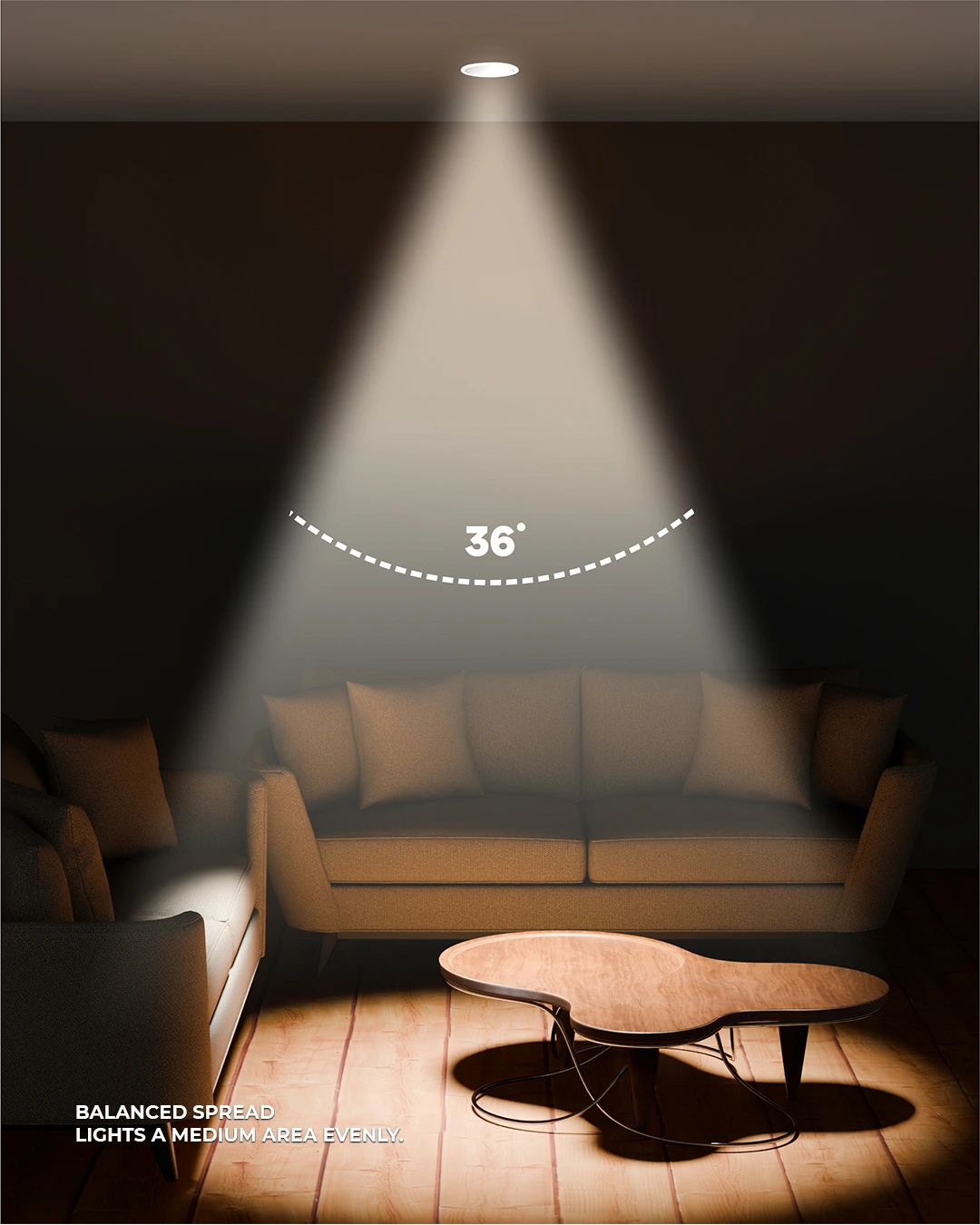
• A medium beam may illuminate seating areas
• A wide beam may provide overall ambient softness
This variation creates rhythm, depth, and visual interest within interiors. Without beam variation, spaces can appear overly uniform and lifeless.
Beam Angles and Ceiling Height
Beam angle selection also changes based on ceiling height.
A narrow beam in a low ceiling may create uncomfortable intensity, while the same beam in a double-height space can create elegant focus.
Similarly, wide beams in tall spaces may lose effectiveness because the light disperses too broadly before reaching the surface.
This is why architectural lighting requires careful planning rather than simply selecting fixtures based on appearance alone.
Choosing the Right Beam Angle
There is no universally “best” beam angle. The right choice depends on the purpose of the space, ceiling height, surface materials, viewing distance, and the desired atmosphere.
The same fixture can create entirely different moods depending on how its beam lighting is controlled. This is what makes lighting both a technical discipline and a design language. At Litomatic, lighting solutions are developed with precision optics and architectural intent, giving designers the tools they need to bring creative office ceiling lighting ideas to life with maximum flexibility.
• Purpose of the space
• Ceiling height
• Surface material
• Viewing distance
• Type of activity
• Desired atmosphere
The same fixture can create entirely different moods depending on how its beam is controlled. This is what makes lighting both a technical discipline and a design language.
At Litomatic, lighting solutions are developed with precision optics and architectural intent, allowing designers to shape spaces with greater control and flexibility.
Conclusion
Beam angles may not always be visible, but their impact is. They influence focus, atmosphere, comfort, depth, and the overall perception of a space.
Great lighting design is not just about adding light, it is about controlling it with intention.By combining precision engineering with architectural understanding, Litomatic creates lighting solutions that help designers shape spaces with accuracy, eleganc